Gear Base Tangent Length
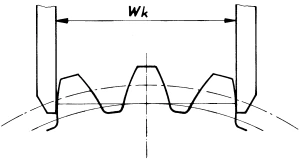
Measurement over multiple teeth or base tangent length (Dişli Kiriş Uzunluğu) is calculated using the number of teeth (Z) and module (m). The pressure angle is assumed to be 20°.
- z = number of teeth of the wheel
- k = number of teeth between the jaws of the caliper
- Wk = Base tangent length over k teeth
* = Rare Modules (Yaygın olmayan modüller)
Standards & References
- DIN 3960 — Definitions, parameters and equations for involute cylindrical gears and gear pairs. Primary source for the base tangent length Wk formula.
- ISO 21771 (EN ISO 21771) — Cylindrical involute gears and gear pairs: Concepts and geometry. International successor to DIN 3960, defines the same Wk measurement.
- DIN 3967 — System of gear fits: Backlash, tooth thickness allowances and tolerances. Defines Wk tolerances for quality control.
- DIN 868 — General definitions and specification factors for gears, gear pairs and gear trains.
Wk (base tangent length) is derived from involute geometry: it measures the distance across k teeth using the involute function inv(α) = tan(α) − α. The formula Wk = m · cos α · [(k − 0.5)·π + z · inv(α)] originates from DIN 3960 §7.3 and is reproduced in ISO 21771 §8. It is used with disc micrometers or gear tooth calipers for inspection of tooth thickness in manufacturing.
Frequently Asked Questions
What is gear base tangent length (Wk)?
Wk is the measurement over k teeth used for quality control and inspection of spur gears, calculated from module, tooth count, and pressure angle.
How do I use this calculator?
Enter the gear module, number of teeth (z), and pressure angle. The calculator returns Wk for each number of teeth spanned (k).
Is this calculator free?
Yes. This Kod5 tool runs entirely in the browser, requires no installation, and is free to use.