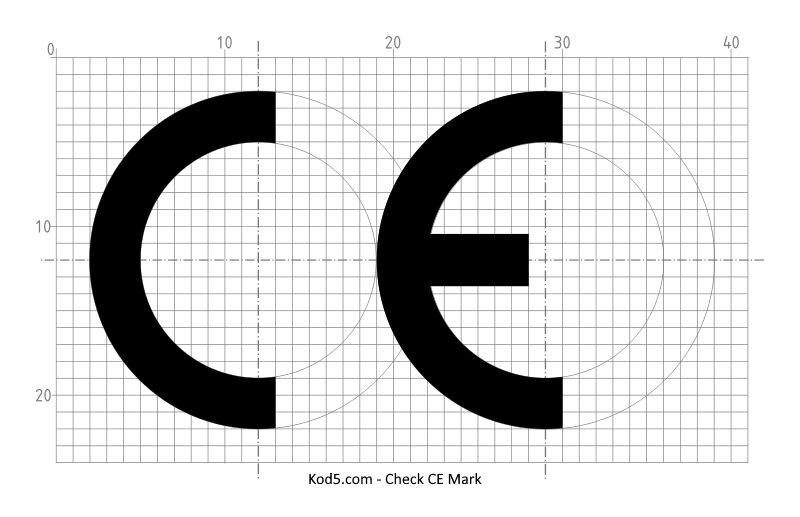
CE Mark visual reference: EU Machinery Safety Directive 2006/42/EC
Why CE Mark Verification Matters
The CE marking is a mandatory conformity mark for products sold within the European Economic Area (EEA). It indicates that the product meets EU safety, health, and environmental protection requirements. Without a valid CE mark, products can be blocked at customs, removed from shelves, or result in heavy fines for manufacturers and importers.
For machinery, electrical equipment, and consumer products, the CE mark is the legal "entry ticket" to the European market. Verifying its authenticity protects your business from liability, recalls, and reputational damage.
China Export vs. Genuine CE Mark
The China Export (C€) mark is a well-known counterfeit that mimics the CE symbol. The key difference lies in the spacing between the letters C and E:
- Genuine CE — the letters follow specific proportions defined by EU Regulation 765/2008. The gap between C and E is carefully measured.
- China Export — the C and E are placed much closer together, often sharing a common vertical alignment. The letters appear compressed.
Because both marks look nearly identical at a glance, visual comparison tools like this checker help buyers, inspectors, and quality assurance teams spot the difference quickly.
How to Properly Verify a CE Mark
- Visual comparison — use this tool to overlay the reference CE mark against the product marking. Check letter spacing, proportions, and alignment.
- Declaration of Conformity — request the EU Declaration of Conformity (DoC) from the manufacturer or importer. It must list the applicable EU directives and harmonized standards.
- Notified body number — for certain product categories (e.g., medical devices, pressure equipment), a four-digit notified body number must accompany the CE mark.
- Product documentation — verify that technical files, test reports, and user manuals are available and consistent with the claimed CE compliance.
EU Directives Requiring CE Marking
The CE mark applies to a wide range of product categories, each governed by specific EU directives:
- Machinery Directive 2006/42/EC — covers industrial machinery, movable machinery, and safety components.
- Low Voltage Directive 2014/35/EU — applies to electrical equipment designed for use within certain voltage limits.
- EMC Directive 2014/30/EU — ensures electromagnetic compatibility of electrical and electronic products.
- Radio Equipment Directive 2014/53/EU — covers products that intentionally emit and/or receive radio waves.
- RoHS Directive 2011/65/EU — restricts the use of certain hazardous substances in electrical and electronic equipment.
Consequences of Fake CE Marks
Using a counterfeit China Export mark instead of a genuine CE mark can lead to:
- Market withdrawal — products can be immediately removed from sale by market surveillance authorities.
- Customs seizure — non-compliant products are blocked at EU borders.
- Financial penalties — fines vary by member state but can reach tens of thousands of euros.
- Liability issues — if a product causes injury or damage, the manufacturer/importer faces legal responsibility without valid CE documentation.
- Reputation damage — being associated with counterfeit markings can permanently harm brand credibility.
Frequently Asked Questions
What is the difference between CE and China Export?
The genuine CE mark has specific letter spacing and proportions per EU regulation. The China Export mark places the C and E closer together, creating a visually compressed appearance.
Can I self-declare CE conformity?
For some product categories, yes. The manufacturer can issue a Declaration of Conformity. However, certain products (e.g., medical devices, PPE) require third-party assessment by a notified body.
Is the CE mark valid outside Europe?
The CE mark is recognized in the EEA (EU + Iceland, Liechtenstein, Norway) and some other countries that accept EU conformity frameworks. It is not a quality mark but a legal compliance requirement.
How do I report a product with a fake CE mark?
Contact the market surveillance authority in the EU member state where the product is sold. You can also report to the manufacturer's national authority or use the EU's Safety Gate (RAPEX) system.